The Progress Formula

A prediction enginefor stuck people.

You know what you want to change. The harder question is why you haven't.

No account. No email. Just try it and see your first score.
or
Sign in with GoogleSign in with Google. Opens in new tab
Sign in to save your results and watch your progress grow over time.
See how it works

This is for people who can list five goals they've half-started, and one they're avoiding right now.

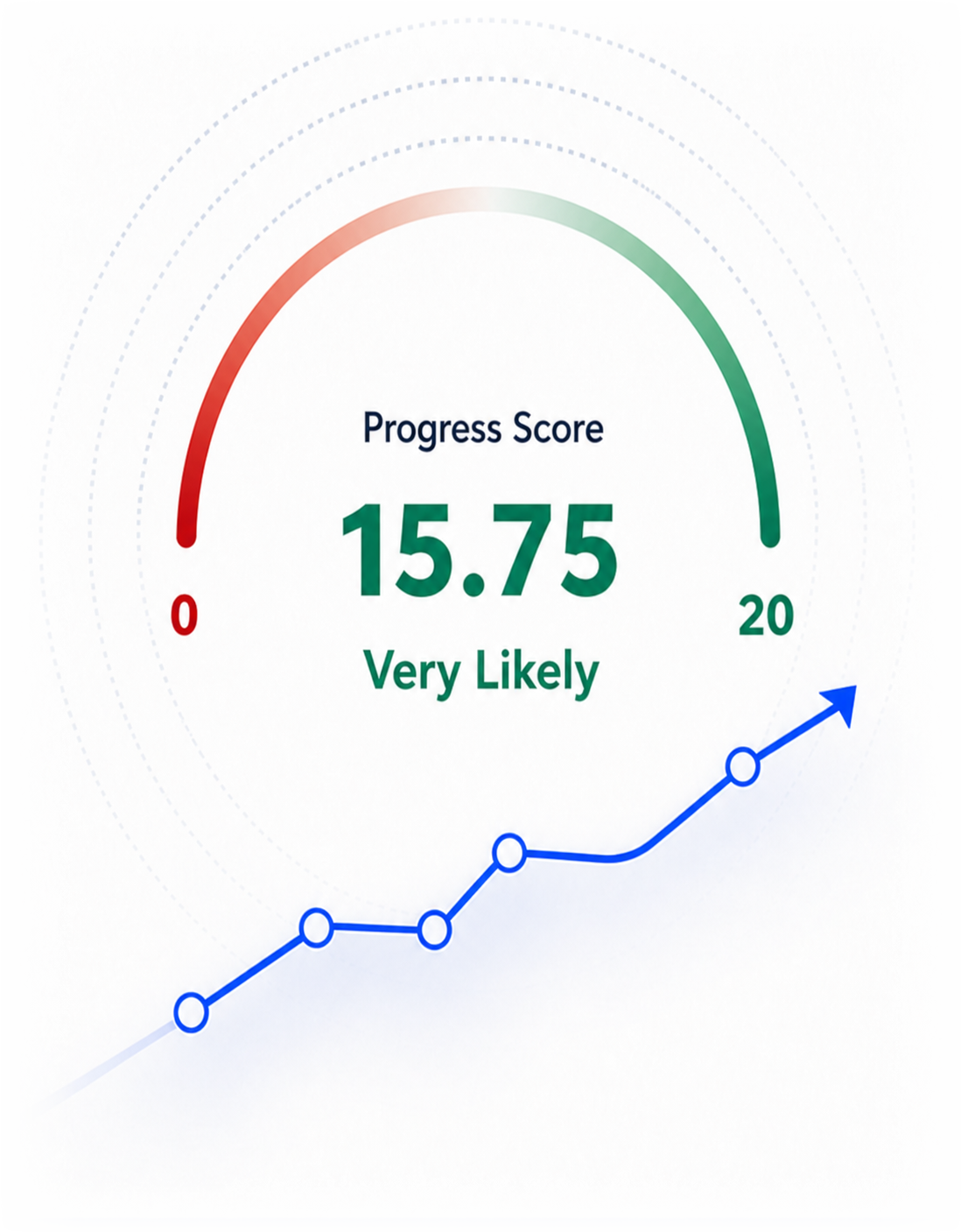
Here's what that looks like in practice. Same goal, two different contexts. On the left, the goal stands alone. On the right, the same goal sits inside a Behavior Design Stack with a bigger why above and a concrete next step below. Dramatically different score.

The Progress Formula
Four factors, one formula. Remember them with the mnemonic DART.
Desire×Awareness
Resistance×Time
Desire and Awareness go on top (higher is better). Resistance and Time go on the bottom (lower is better). A high score means the design is working for you, not against you.
Before redesign
The original goal, floating alone
"Go to the gym more"
Desire, Awareness, Resistance, and Time all have to anchor to this one vague statement.
FactorScoreWhy
Desire2Who actually wants to go to the gym?
Awareness3No trigger, nothing to remind me
Resistance7Gym, commute, gear, changing, sweating
Time6An hour plus, start to finish
(2 × 3) / (7 × 6) = 6 / 42
0.14
Not because you don't want it. Because nothing in the design gives it a chance.
After redesign
Behavior Design Stack
A top layer with the bigger why, the original goal in the middle, and a concrete next step at the bottom.
Top layer · the bigger why
"Live a long and healthy life, so I'm around to see my kids grow up"
Desire anchors here: increases from 2 to 9
The original goal (unchanged)
"Go to the gym more"
Bottom layer · next step / tiny action
"Put gym bag by the front door before bed"
Awareness anchors here: increases from 3 to 7
Resistance anchors here: drops from 7 to 2
Time anchors here: drops from 6 to 2
(9 × 7) / (2 × 2) = 63 / 4
15.75
Nothing about the goal changed. Only the context around it did.
The core insight

The problem isn't discipline. It's four invisible patterns that show up every time you stall.

They look different for every goal, but the underlying structure is always the same. The Progress Formula scores each one so you can see which are working for you, which are working against you, and what knobs to turn to boost your odds of success.

What each DART factor means
Desire
How badly you want it.
Awareness
The odds you'll remember to do the next action at a moment when you could reasonably do so.
Resistance
What's in the way. Friction, energy cost, environmental obstacles.
Time
How long the next step actually takes.

Is this for you?

Good fit if you are…
  • Motivated but stuck in cycles of trying, falling off, and starting over
  • Overwhelmed by options and unsure where to focus first
  • Someone who suspects willpower is not actually the problem
  • Willing to run small experiments and update based on what you observe
  • Looking for a diagnostic tool, not a coach who tells you what to do
Not a fit if you are…
  • Looking for a rigid daily program or step-by-step curriculum to follow
  • Hoping for a tool that guarantees results without reflection or iteration
  • Not willing to honestly rate your own desire, friction, and follow-through
  • Expecting a quick fix with no behavioral redesign required
  • Needing clinical or medical support for behavioral health concerns
FAQ

Common questions

What does a high DART score mean?

A score of 3 or above is a positive signal. The behavior, as currently designed, has reasonable follow-through odds. It is directional, not a guarantee.

What does a low DART score mean?

A low score (below 1) is not a warning to be careful. It is a strong signal that the plan, as currently structured, is unlikely to succeed. Not because you have weak willpower, but because the design itself is working against you.

How do I improve my DART score?

Two moves. Get more specific about the very next step you can actually take right now. And connect the goal to the deeper reason behind it, because the thing you initially say you want is rarely what you actually want.

Can I use this for work goals?

Yes. The factors apply to any behavior: professional routines, sleep, exercise, creative work, communication habits.

Do I need an account?

No. You can try it right now without signing up. Sign in with Google only if you want to save your canvas and score history across devices.

Stop guessing. Start progressing.

Map your options, score your readiness, and fix the hidden constraints before you start a plan that was never going to work. No account required.

or
Sign in with GoogleSign in with Google. Opens in new tab
Sign in to save your results and watch your progress grow over time.